I appreciate your posts on anger because it’s a huge problem issue for me. I’m not really sure how to answer these questions because my parents left when I was young (around two). They came to visit sometimes so I had parents, but they were more like guests and not really like parents. I think my parent ego state is based on my father’s parents (grandparents). So if there's anything I've said here that would help me deal with anger better, I'd love to hear it.
My Parent ego state and anger
When my grandfather was angry he would (Hit, withdraw and sulk, shout, swear, give a lecture, get sarcastic, eat, fight, get depressed and so on)
Say - nothing
Do – slam the door on the way out and leave for awhile
When my grandMother was angry she would:
Say – curse, call me bad names, scream, rant
Do – threaten to send me away, threaten to send my brothers away, threaten to hurt me, blame me for ruining her life
My Child ego state decisions about anger
When I was angry grandmother would
Say – I was ungrateful, call me names, scream at me
Do – whip me, blame me, hurt me
Feel – she hated me more than usual
When I saw grandmother or grandfather angry I would
Say - nothing
Do - hide
Feel - scared
What did your grandmother and grandfather say about expressing anger. (OK, not OK, good, bad, time & place, men & women, etc) I learned very young that it was not acceptable for me to be angry or even look angry in front of them…ever. I don't remember them ever saying anything about it.
As a teenager did you get rebellious and angry? If so how did you express it and how did the parent figures respond? As a teenager, I hated everything about living. I did a lot of drugs and drank. I was not good to myself and did dangerous things. Sometimes I ran away. I stayed away as much as possible. Sometimes my grandmother found my stash and she flushed it (or hell, maybe she really kept it for herself) and she'd tell me I was trash like my mother and a nutcase like my mother's father. Fortunately, I had a couple of really good teachers in high school who motivated me to stay out of trouble and encouraged me to escape home by finding work rather than laying drunk in the alleys. They saved my life.
Summation of early decisions = Anger is forbidden.
---------------
Results
This case study is a good example of how a person can acquire contradictory script messages about anger and its expression. As we can see Larissa made a Child ego state decision:
“Don’t feel anger”
or at least
Don’t express your anger”
This is held in the Child ego state. At the same time she would have introjected her grandmother’s anger expression into her Parent ego state. This is shown with the statements like:
When my grandMother was angry she would:
Say – curse, call me bad names, scream, rant
and
When I was angry grandmother would
Say – I was ungrateful, call me names, scream at me
Do – whip me, blame me, hurt me
Thus she has a strong model which shows that it is OK to feel angry and to express that anger in a forthright and demonstrative way. Thus Larissa has a contradiction in her personality in this way.
It is probably safe to say that the early decisions are more influential in the personality than the models, however at the same time the modelling of behaviour is recognised as a significant factor in personality development.
Logically there are 4 possibilities
1. Decision made with consistent modelling
2. Decision made with contradictory modelling
3. Decision made with no modelling
4. No decision made but with modelling of behaviour
Larrisa is possibility number 2 and this could lead to some outright
contradictory behaviour with anger at times. Or what is more likely is that the decision behaviour will by overt with the modelled behaviour being expressed in a more convert way. Indeed this may be the case with Larissa (however this is based on very minimal information)
She says:
As a teenager, I hated everything about living. I did a lot of drugs and drank. I was not good to myself and did dangerous things.
This could indicate that the permission to express anger has resulted in her expressing anger at herself. Which resulted in some self destructive behaviour. In relationships with others there maybe a suppression of the anger as the decision demands.
Graffiti
Showing posts with label early decision. Show all posts
Showing posts with label early decision. Show all posts
Wednesday, June 8, 2011

Thursday, April 22, 2010
Relational contact with the AC **
In Transactional Analysis terms it is the Adapted Child (AC) ego state where self destructive urges reside in the suicidal individual. The young child makes an early script decision that is known as the “Don’t exist” decision or the suicide decision. It is the AC part of the personality that encompasses that decision and thus subsequent suicidal urges are seen to come from there.
In the treatment and management of the suicidal one can give the client an opportunity to seek to clarify this ego state or part of their personality. One way to do this is to get the client to project that part of their personality out onto the environment. They can project it into an empty chair or they may draw it on a piece of paper thus allowing it to be projected out in that way.
This can be shown diagrammatically as:

The AC is projected out onto some kind of ‘screen’ allowing the client's and therapist’s Adult ego states to see it in a clearer form. Once done the client can see, understand and experience this aspect of the personality in more profound way than if it had never been ‘externalised’ before. However the point at hand is it also allows the therapist to understand it much better and begin to relate to that part specifically.
In my view one of the most important therapeutic undertakings with the suicidal client is precisely this. For the therapist to establish relational contact with the self destructive aspect of the client. When the client makes such a projection then such an activity is possible.
But why is it seen as such an important action? The answer to this question addresses the spheres of humans, relationships and attachments. The research is prolific and emphatic about the health promoting ramifications of human relationships and attachment. Humans are much more psychologically robust if they have substantive relationships (attachments) in their current lives. Indeed it is better to have attachments of a poor quality than no attachments at all. Humans need relational contact and they are healthier when they have it.

However it should be noted that what is being suggested here is different to the usual kind of relationship formation. It is different than two people meeting and over time forming a bond and attachment. The difference is that the therapist is addressing one specific aspect of the client’s personality rather than the person as a whole.
It seems safe to say that in normal relating this aspect of the personality would rarely be addressed or even recognised between the two people so a different dimension of relating is being discussed here. I do not know of any research on this specific type of relating. All I can do is make statements on what I have observed over the years of working like this in therapy. In addition I must say that I have rarely seen others set about to establish this type of relational contact with a client.
However my conclusion is that this type of relational contact is of considerable therapeutic value. A part of the client’s personality, the Adapted Child ego state, that rarely if ever gets directly addressed by another all of a sudden is not only being address but is being sought for relational contact. Some person all of a sudden is seeking it out for a relationship and attachment. Someone wants to get to know it and relate to it probably for the first time ever in its life. To treat it with respect and compassion again probably for the first time ever in its life.

Not uncommonly there is some initial resistance but that usually subsides quite quickly, after about three or four episodes of relational contact. Then there tends to be a dropping of its ‘harshness’ for the want of a better word. Initial contact from the therapist can be met with a response of glaring, subdued, abrupt, unfriendly, desolate and so forth. (I have just picked some words that try to explain the types of responses that can happen.) (It is similar to dealing with the lilith of a client)
It is a like a young child who has been ignored and maybe even derided for many years, all of a sudden is sought out in a compassionate way by a friendly other. It will feel most strange for the child, they wont trust it but they quickly discover that it feels nice. They may even be angry and hostile about being treated like that for such a long time. But if the other accepts the anger and hostility without abandoning it or hitting back angrily then the Child will start to find it is most appealing and then will start seeking it out by itself.
Graffiti
Thursday, March 4, 2010
Life script analysis 4
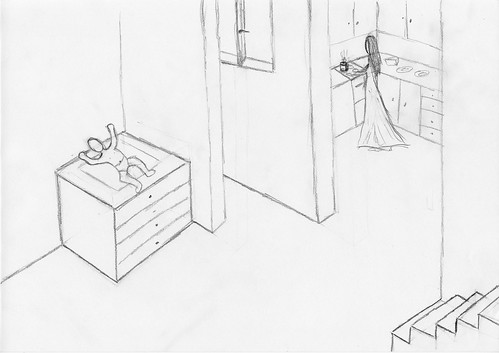 For a larger version of this go to here. And click on "All sizes"
Story of drawing.
Mother is busy in the kitchen. The baby is waiting to be taken care of. It is crying, crying and crying. The baby is noisy and needy but it does not get picked up.
It’s not mother’s fault because she is simply busy. It’s the baby’s fault.
Father is working and mother is overloaded. She is just young and has duties that she never had to deal with before. The baby is just one extra duty on a long list. The baby is not 1 year old yet. It is not an emotional priority.
Why should this baby come first. Mother was overloaded and creates a sense of guilt in the child.
It thought, “I don’t deserve to get my needs met”. “I make mother’s life harder, it would be better if I was not here”.
------------------------
Comment on story
In terms of the fight, flight or freeze response to stress there is clearly no fight response in this case. It shows how the suicide decision can result in such circumstances as it did here. The baby does not view mother as treating it unfairly which would tend to be the fight response, “I am not being treated in the way that I should be, so its their fault” (anger).
Instead the response is to see mother as being over burdened with her domestic duties already and the baby is simply making mother’s life harder, thus it is the baby’s fault for it not being picked up. Thus it is not hard for the child to make the decision that things would be better for all concerned if it was not here. One could see this as the flight response and the feeling reaction is one of sadness and passive acceptance.

In being questioned on this scene the individual found it hard to say what her thoughts and feelings were. She stated that there were very few words and there was more feelings and noises instead. This gives the indication that the suicide decision in this case could be pre-verbal which also fits with the child being less than one year old.
If this is the case then one knows that the decisions made in this scene, including the suicide decision are going to be very resilient because they were made at such a young age before the child even had language. This implies that this individual will to some extent be potentially suicidal all her life. These very early decisions form the foundations of the personality and thus they are hard to alter through counselling compared to decisions made at older ages. The impact of the decisions can be changed but to expect them to be completely altered would be quite unusual and unrealistic. Thus there will always be a suicide decision there to some extent.

Of course a person of less than one year old can not recall such events as described and drawn here. For the purposes at hand it does not matter if it actually happened or not. These drawings and descriptions are really just visual, cognitive and kinaesthetic representations in the person’s mind, of the structure of their personality. This event describes part of the personality for instance in cognitive behavioural therapy terms, the thinking errors the person has. It does not matter if the event even occurred as it is the visual, cognitive and kinaesthetic representation the person currently holds in their mind which allows them to have consistent personality structures. It is what the person uses to actually have a personality.
I have always been surprised at how easily people will produce these early distressing scenes as well as being convinced of their authenticity. There is never a sense of people making up a story or telling a tale and so forth. Instead they produce a drawing of what they believed happened to them and as has been seen at times they can be quite elaborate and detailed. In addition the feelings and early decisions which were made as a result of the event can also be quite easily articulated.
Graffiti
Subscribe to:
Posts (Atom)
 |
 |
 |
 |
 |
 |
 |
 |
 |
 |
 |
 |
 |
 |
 |

