Showing posts with label suicide. Show all posts

Saturday, November 26, 2011

Book award party

Last week we had a party for the book award I recently received.

Here is a photograph of myself with the award certificate.

Tony & award.
Note the Toblerone and the strawberrys!

Here is what the publisher had to say about the award.

The list of university and college libraries that stock the book contuinues to grow. I must admit that I am a bit surprised at the size of the list as the book is still not even one year old. I would have assumed that psychology, social work and psychotherapy degrees would have to plan more on what texts they would use for next year and so forth.

University of Waterloo (Canada)
University of Manitoba (Canada)
Saint Francis Xavier University (Canada)
University of Victoria (Canada)
Vancouver Island University (Canada)
Ryerson University (Canada)
Royal Roads University (Canada)
Simon Frasier University (Canada)
St. Clair College (Canada)
Universite de Montreal (Canada)
Memorial University (Canada)
Mount Saint Vincent University (Canada)
Mount Royal University (Canada)
Wilfrid Laurier University (Canada)
Cambrian College (Canada)
Kwantlen Polytechnic University (Canada)
University of Lethbridge (Canada)
Concordia University (Canada)
University of Guelph (Canada)
Library and Archives Canada (Canada)

Maribor General Hospital Library (Slovenia)

Stellenbosch University Library (South Africa)

Mitt hogskolan library (Sweden)
Stockholm University (Sweden)

PJ Library (Norway)
University of Bergen (Norway)
Norges teknisk-naturvitenskapelige universitet (Norway)
University of Oslo (Norway)
University of Tromso (Norway)

Freie Universitat Berlin (Germany)
Humboldt University of Berlin (Germany)
State and University Library of Dresden (Germany)

University of the West of England (UK)
Derbyshire library (UK)
University of Plymouth (UK)
Manchester Metropolitian University (UK)
Lancaster University (UK)
University of Hull (UK)
University of East Anglia (UK)
University of Cambridge (UK)
Oxford University library (UK)
University of Exeter (UK)
Coventry City Council library (UK)
Bromley Library service (UK)
Cadbury Heath Library (UK)
Kingswood Library (UK)
Nottingham Central Library (UK)
Yate Library (UK)
British Library (UK)
Ebook library London (UK)
Hounslow Library (UK)
Barnet London Borough Library (UK)

National library of Scotland (Scotland)

University of California San Diego (USA)
Open Library. California State Library (USA)
University of Washington (USA)
Norwich University (USA)
Ithaca College (USA)
Marquette University Raynor Memorial Library (USA)
University of Massachusetts Amherst (USA)
Williams College Massachusetts (USA)
National Library of Medicine Maryland (USA)
Illinois State University (USA)
Loyola Marymount University California (USA)
University of Michigan (USA)
Central Michigan University (USA)
University of North Carolina Chapel Hill (USA)
University of Missouri-Columbia (USA)
Akron-Summit County Public Library, Ohio (USA)
University of California Merced (USA)
University of North Carolina Greensboro (USA)
Library of congress (USA)
University of California San Franisco (USA)
Mt. Hood Community College Library Oregon (USA)
National College of Natural Medicine Oregon (USA)
Oregon Health and Science University (USA)
Northeast WI Public Libraries (USA)
College of DuPage Illinois (USA)
Boston College (USA)
University of Chicago Illinois (USA)
University of North Texas (USA)
Laredo Public Library Texas (USA)
University of Texas-Pan American (USA)
University of Texas at Austin (USA)
University of Puget Sound (USA)

Executive Counseling and Training Academy (Singapore)
Ngee Ann Polytechnic Library(Singapore)
Singapore Polytechnic Library (Singapore)
National University of Singapore (Singapore)

LaTrobe University (Aust)
Murdoch University (Aust)
Monash University (Aust)
Victoria University (Aust)
Bankstown Campus library (Aust)
University of Sydney (Aust)
Queensland University of Technology (Aust)
Deakin University (Aust)
University of Adelaide (Aust)
University of Western Australia (Aust)
University of Ballarat (Aust)
University of New England (Aust)
University of Western Sydney (Aust)
Charles Sturt University (Aust)
Curtin University (Aust)
Australian Catholic University (Aust)
University of Newcastle (Aust)
Bond University (Aust)
University of Melbourne (Aust)
James Cook University (Aust)
National Library of Australia (Aust)

Trinity College Dublin (Ireland)
Dublin Institute of Technology (Ireland)

University of Auckland Library (New Zealand)
University of Canterbury (New Zealand)
Lincoln University (New Zealand)
Northtec library (New Zealand)
Auckland University of Technology (New Zealand)
Unitec Institute of Technology (New Zealand)
Eastern Institute of Technlogy (New Zealand)
University of Otago (New Zealand)
Rotorua District Library (New Zealand)

City University of Hong Kong (China)
National Cheng Kung University (Taiwan)

Dress woman

Graffiti

Thursday, November 3, 2011

Book review - Part 2

This comprehensive book review comes from the magazine of the Institute of Transactional Analysis which is a UK based association.

To view in larger size:
Click on picture > click on actions > click on view all sizes

Review 1

Review 2

Review 3

Graffiti
Saturday, June 25, 2011

Book update

A part from an interview I did on the book


Interview on the book - Working with suicidal individuals.

Question - Does your own suicide experience have something to do with your interest in this topic? And why did you decide to incorporate information about it in this book?

Answer - In answer to your question, probably. My own suicidal experiences in adolescence would have something to do with my interest in the topic but it’s not something I have ever consciously thought about. I have no desire to have some sort of crusade or campaign to stop adolescent suicide.

Working in the field of psychology one comes across suicidal people quite regularly. Whilst I probably have a personal interest in the topic, when working as a psychologist it is wise to be well informed on the topic of suicide anyway. Hence I have specialised in the area over my years of practice.

Since writing the book were I refer to my two suicide attempts as a teenager I have had colleagues tell me how brave I am to make such a public disclosure and they would never tell of theirs. I have been surprised at the number of colleagues who have made suicide attempts or been very close to acting on their suicidal urges at some point in their life.

I have experiences in my life that I would keep private but this is not one of them. I see no difficulty in disclosing such a thing. I have never had anyone tell me they look down on me for it or because I did that it should disqualify me from being a psychologist. I suppose some may think but there is not much I can do about that.

I think it provides me with a unique insight into the psyche of the suicidal adolescent and makes me more qualified to work with such young people. Which is what I have done and I have endeavoured to pass that insight onto others though the book.

----------------------

Latest review from a very experienced and ‘decorated’ social worker who has practised well over 30 years in a wide variety of mental health areas.

Tony White   Working with Suicidal  Individuals
A Guide to Providing Understanding, Assessment and Support.
 
I have read Rosemary Napper and Dr. Jan Hennig's reviews of Tony's book and agree with all that they say.   I would however like to add a few comments of my own after recently finishing the book.
 
My approach was three-fold: 
1. What don't I know
2. What is it like for those new to the subject
3. My opinion of the total work.
 
When I began my training in clinical TA Tony had just qualified as a TA clinician, and I remember being amused  and fascinated by the way that he then proceeded to examine every facet of the theory from every last perspective.   Some 30 years later, having read this book, I rejoice that he has brought the same scrutiny and rigour to his subject.   His work is a valuable and much-needed text book or guide to this very dense and complicated field.   It is comprehensive yet easily digestible:  essential qualities that are, unfortunately, all too rare in many similar works.    His aim:  "to add to the field in the assessment, management and understanding of the suicidal person" has been admirably achieved.
 
One of the things that struck me as I read was how well the TA structure of personality and the system of transactions lend themselves to the whole field of suicidal individuals, and Tony defines and describes them so clearly in Chapter 3.
 
Secondly, reading Chapter 4 The Suicide Decision, really brought home to me the secret of Tony's success from my perspective:  Eric Berne, the author of TA taught us:  "If a seven-year-old can't understand it, don't say it !"  Tony's description of the early decision uses clear, simple, understandable language and a step-by-step style, which totally facilitates the understanding and grasp of this complex subject.   In toto, we take a fascinating walk through the facts rather that drowning in facts, figures and technical language.   The same essential skills are demonstrated in Chapter 6 - Reactions to High Stress where the coverage is very clear and wonderfully complete - eg. self-harming techniques v. suicide - never too nit-picking and boring but systematically and interestingly described.   I rejoice.
 
Other aspects of the book that I find worthy of note are:
 
1.  pp.119-124 (Suicide and prisoners)   I appreciate the care given to examining the prison population and the respect with which the author approached them.
 
2.  The clarity of the many charts and diagrams eg, p.128 (the cycles of depression).
 
3. The emphasis given to the times of severity and recovery, which would be surprising and important for newcomers to the field. p.131 (Recovery from depression)
 
4.  pp194-96  I was very proud of Tony's courage in using plain speaking, and his very empathic and humane approach to explaining and promoting understanding of the causes of pseudo suicide.   I see this as a tacit invitation to others to drop their prejudices and adopt a similar perspective.
 
5.  pp211-12  working with suicidal ambivalence.   The considerable amount of detail with FC and AC which is so very necessary was excellent, and again so clear....;...it made me sing !!!
 
6.  Suicide Time Lines Ch.13 - are not very often seen as important - good to see them here.   Tony gets another star for thoroughness !
 
7.  Redecision Therapy Ch/15 - great to see this splendid technique described in such detail- the most thorough and effective that I have found, especially for this life and death issue.
 
Tony, Eric Berne would be proud of you.   This is a splendid book, perfect for newcomers as well as for those long in the field.   As I read I began to smile:  you have taught us all to do the great detective work required for these people.   I hereby christen you the Poirot of Psychotherapy - a Detective  Extraordinaire!!!

Hugged by words


The book has now been out 6 months and can be found in many academic and university libraries. And these are only the ones that I have found.

Additions of note have been in Canada and some recent quite prestigious universities like:
University of California San Diego (USA)
University of Western Australia (Aust)
National University of Singapore (Singapore)

It seems a book based on the Transactional Analysis theory of suicide is being used in such university programmes as social work, nursing, medicine, psychology, psychotherapy and counselling.


University of Western Australia (Aust)
Victoria University (Aust)
Charles Sturt University (Aust)
Curtin University (Aust)
Australian Catholic University (Aust)
Bond University (Aust)
University of Melbourne (Aust)
James Cook University (Aust)
National Library of Australia (Aust)
Maribor General Hospital Library (Slovenia)
Stellenbosch University Library (South Africa)
Mitt hogskolan library (Sweden)
Stockholm University (Sweden)
PJ Library (Norway)
University of Cambridge (UK)
Oxford University library (UK)
Coventry City Council library (UK)
Bromley Library service (UK)
Cadbury Heath Library (UK)
Kingswood Library (UK)
Yate Library (UK)
British Library (UK)
Hounslow Library (UK)
Barnet London Borough Library (UK)
National library of Scotland (Scotland)
Executive Counseling and Training Academy (Singapore)
Ngee Ann Polytechnic Library(Singapore)
Singapore Polytechnic Library (Singapore)
National University of Singapore (Singapore)
University of California San Diego (USA)
Marquette University Raynor Memorial Library (USA)
University of Massachusetts Amherst (USA)
National Library of Medicine Maryland (USA)
Loyola Marymount University California (USA)
University of Michigan (USA)
University of North Carolina Chapel Hill (USA)
University of Missouri-Columbia (USA)
Akron-Summit County Public Library, Ohio (USA)
University of California Merced (USA)
University of North Carolina Greensboro (USA)
Library of congress (USA)
University of California San Franisco (USA)
Mt. Hood Community College Library Oregon (USA)
National College of Natural Medicine Oregon (USA)
Oregon Health and Science University (USA)
Northeast WI Public Libraries (USA)
College of DuPage Illinois (USA)
Boston College (USA)
University of Chicago Illinois (USA)
University of North Texas (USA)
Laredo Public Library Texas (USA)
University of Texas-Pan American (USA)
University of Texas at Austin (USA)
Trinity College Dublin (Ireland)
Dublin Institute of Technology (Ireland)
University of Auckland Library (New Zealand)
Auckland University of Technology (New Zealand)
Eastern Institute of Technlogy (New Zealand)
University of Otago (New Zealand)
Rotorua District Library (New Zealand)
University of Waterloo (Canada)
Wilfrid Laurier University (Canada)
University of Guelph (Canada)
Library and Archives Canada (Canada)
City University of Hong Kong (China)

rain girl

Monday, March 21, 2011

Suicide and being killed

In my book I take some time to look at what actually constitutes suicide. A definition of it so to speak. It seems to me that most have quite a simplistic and one dimensional approach to it. One can conceptualise of three groups of people who could be considered suicidal in some form.

Group 1. Those who plan to kill self, have made the suicide decision and the suicidal ambivalence is heavily weighted to AC side. These people typically report feeling depressed, anxiety, despair or some other kind of pervasive angst. This is what most would see as the suicidal group.

Group 2. Those who will never do the act of suicide them self but may have made the suicide decision. It is simply either not in their behavioural repertoire or they have made a special kind of suicide decision.

gun to girl head

There are seven different suicide decisions of which two are:

I will get you to kill me

I will kill myself by accident

How does one get to kill self by accident. There are a number of ways

Car or motorbike accidents
Drug overdoses
High risk sports
Working with dangerous animals

How does one get someone else to kill them. There are a number of ways

Domestic violence. Behave in a particular way with a very violent other

Death by cop

Become involved in criminal activity where people kill each other - both as police and the crims.

Get the state kill you with the death penalty

Go voluntarily into a war zone

Refuse treatment for a life threatening illness

Shot man Vietnam

Group 3. This is a more contentious definition of suicide. These people present as clearly non suicidal. They will state they feel good and have everything to live for. In addition they consistently place self in circumstances voluntarily where the likelihood of being killed significantly increases. Examples could be Steve Irwin and Peter Brock. They appear quite non suicidal and yet repeatedly place self in circumstances where the risk of death significantly increases. Is this suicidal behaviour or not? This can also apply for someone who smokes 50 cigarettes a day. Is that suicidal behaviour?

smoking girl

However what I wish to discuss at this juncture is a piece of research I came across

“Female soldiers' suicide rate triples when at war”.
Recent research reported in the magazine USA TODAY (March 2011) Gregg Zoroya
(http://www.usatoday.com/)

This research on US military found

1. When female soldiers deploy to Afghanistan and Iraq the suicide rate triples from 5/100,000 to 15/100,000.

2. When male soldiers deploy to Afghanistan and Iraq there is a 30% increase in the suicide rate from 15/100,000 to 21/100,000.

This could be seen to support the contention that going into a war zone can be used as a way to fulfil the suicide decision:

I will get you to kill me.

Obviously in a war zone there are plenty of people trying to kill you.

Or at least those who have made some kind of suicide decision

Those who are actually deployed may be a self selecting group to some extent. Those who have made this suicide decision will get themselves into the circumstances where they are more likely to be deployed than other non suicidal people in the military. One reason why the suicide rate increases is because the group has selected in, more suicidal people.

Army homeing pidgeons

In the report on the research the researches say the usual stuff. People deployed to such war zones are more stressed and so forth and this maybe the cause of such statistics.

There is an alternate explanation. Stress has never made anyone suicidal. What stress can do is make an already suicidal person more likely to act on their self destructive urges. Thus a person who has made the suicide decision is more likely to end up in a war zone and when stressed is more likely to act on that decision. Hence the rate of suicide goes up.

Graffiti

Tuesday, February 15, 2011

Writing

I had forgotten what it was like and how it worked. For the past two weeks the publisher had asked me (twice!) to put in the proposal for the book on emotions. I had thought about it, meant to start it, “ummed and ahhed” about it all and nothing had happened.

Camel
To all you smokers out there, remember the cool, smooth flavour of Camel.


Well stuff was happening but it was all behind the scenes. My mind, as I ate my dinner, went for my walking exercise, bathed and other such domestic tasks was slowly but surely getting it together. How do you put together an 80,000 word manuscript? What is the overall structure of the thing which of course is the most important part of all. It was not like I had set myself the task to ‘get the overall structure of the book’ it was kind of thinking about this bit here and that bit there. Definitely done in a non systematic way.

On my computer desk top is the folder which has all the stuff in it for what the publisher is wanting. It just sits there in the bottom left hand corner. Today I sat down at my computer and opened up the folder. I had no intention of doing that, it kind of just happened. Then three hours later it was done. It was one of those things where you start something and then you look at the clock and realise three hours have gone by. All of a sudden you realise you have that sort of numb feeling behind your eye balls because your concentration has been so intense for such a protracted period of time.

Walker

It reminded me of how I wrote the manuscript for the book on working with suicidal individuals. I never forced anything, it happened and came when it wanted. At times I was a bit concerned as I would go for a week or two with out writing anything. But then it would come and I would write a whole bunch of stuff.

Back to the current book.

I have an exercise for anyone out there who might like to do such a thing. You need to get four separate pieces of paper (Blank sheets with no lines on them).

On the first page draw a picture of an angry person
On the second page draw a picture of a sad person
On the third page draw a picture of a scared person
On the fourth page draw a picture of a happy person

Then if you like send them to me and I will analyse them.

Girls

Graffiti

Sunday, January 16, 2011

Definition of suicide rate

As the previous post noted, last week I ran a workshop on working with suicidal individuals. Whenever I begin such a workshop I usually begin with a few statistics. For example I might say that in Australia today 8 people have ended their life by their own hand.

I then go onto say that these figures are conservative possibly very conservative.

The first reason I cite for such a hypothesis is that governments usually will define suicide in such a way that it is difficult to attain. It is defined such that the official cause of death by suicide is hard to make. The logic behind this is usually governments want the suicide rate as low as possible because it is not a good look for them if the numbers of people killing themselves is high.

Bike ride

By pure coincidence I today came across a statement about the official classification of suicide in Western Australia. And reassuringly it supports what I have been saying in workshops for a long time which is a good thing really. It’s always nice to find out that what you have actually been saying for all these years is actually true!

This comes from the “Occasional Paper Number 2” which is a state government publication produced by the Western Australian Drug Abuse Strategy Office. It states,

“In Western Australia the Coroner’s Act requires a verdict of suicide if the Coronial investigation reveals the death was intentionally self inflicted. If there is any doubt the case will not be classified as a suicide and the benefit of the doubt is given to the deceased. “Suicide should never be presumed, but must always be based on some evidence that the deceased intended to take his ( or her) own life” (Mathews & Foreman, 1993, p.13). In effect, this means that there must be overwhelming evidence that the deceased intended to take their own life.” (p19)

South Korea Chiefs Of Defence

In addition to this there are three other reasons why the official rate of suicide is conservatively low.

1. People do not want to leave their loved ones with the stigma of having a member of the family who died by suicide. So they make it look like an accident.

2. People do not want to leave their loved ones with guilt and doubt about how they should have seen the signs and should have somehow done more to help. So they make it look like an accident.

3. Some life insurance policies do not pay out on suicides. So they make it look like an accident.

One of the easiest ways to make a suicide look like an accident is with a car crash. I have had many suicidal people over the years say this directly to me. That they will use a car crash to suicide for some combination of the reasons cited above.

Last year in this state 193 people died due to car crashes. I would suggest it is quite possible that half of those could be “car suicides” rather than “car accidents”.

Girl vomit

We see the police classifying crashes due to things like fatigue because there are no skid marks. Maybe there are no skid marks because the person was quite awake and simply drove off the road directly into a tree.

At other times we see the police state that alcohol was a factor in the car crash. Suicide research clearly shows that at the point of making a suicide attempt many if not most people are intoxicated.

Then there is the area where suicides and accidents blur into one another. Some people are in great pain and can be feeling suicidal or self destructive to varying degrees. Whilst they do not specifically set out to end their own life they will put themselves in situations where the possibility of a fatal accident significantly increases. If such an fatality should occur, was it an accident or a suicide? It’s a bit of both and again car suicide/accidents are an easy way to achieve such a death.

With the coroner requiring overwhelming evidence for a suicide to be recorded there are going to be a significant number of car suicides recorded as car accidents. So what do you do? You can’t legislate for this. Are you going to lower the speed limit or legislate such that you can take away the persons drivers licence for drink driving. Of course for the suicidal individual such things are a nonsense.

Graffiti

Saturday, September 25, 2010

Three suicide relationships

Suicide pact relationship

Suicide pact transaction


Suicide relationship 2

Suicide relationship 2

Suicide relationship 3

Suicide relationship 3

A work in progress.

Cat leaping

Graffiti

Wednesday, September 22, 2010

The suicide relationship

My pommy mate Kahless mentions in her comment on the last post about suicide pacts. A suicide pact is a thing which most people find a really bizarre thing for people to do. Indeed that is one of the reasons why it gets the press coverage it does as my good friend Kahless directs us to here.

But as with so many things like this in psychology if you take a closer look it is not all that weird. It ends up being just a slight modification of normal human behaviour.

I refer to a thing called the suicide relationship. In one instance this can be a relationship where two people make a plan to suicide together and thus we end with what is commonly known as a suicide pact. However there are derivatives of this.

One of the ‘protective’ factors in suicide risk is if the individual has family or other close attachments in their life. Such as person is seen to be at less risk of suicide than the person who has no close relationships. Having close attachments makes for a more psychologically robust person.

Kiss stealing

However this can be very misleading and when making a suicide risk assessment one needs to enquire deeper into the nature of such relationships. For some people suicide is seen as every persons right to choose. Every person has a right to die when and how they want to. And this view can put up a substantive argument to support itself and it is a view held by a section of the community.

If a suicidal individual has a close attachment with a person who thinks like this then the protective factor in the relationship is not protective at all. In essence you have a suicide pact between two people where only one is suicidal but the psychology of the relationship is not all that different to a suicide pact where both are suicidal.

Now I am not suggesting that this non suicidal party in the relationship is an evil and uncaring person. They may have great affection and love for the suicidal individual. They may have seen their suicidal ‘partner’ go through great angst over a long period of time and there is an argument for the view that people have the right to choose when to die. Ongoing physical pain is no different than ongoing psychological pain.

Rope woman

There is indeed a further variant of this suicide pact relationship. In the relationship just described the non suicidal party ‘advocates’ suicide for the relief of the other. Under some circumstances the non suicidal party advocates suicide for the other so as to gain relief for self. This may seem abhorrent to some and a very selfish act but it is just natural human psychology.

For instance living with a suicidal person is a very emotionally taxing thing to do. It is a very stressful set of circumstances to live under. If a husband has been living with as suicidal wife for a couple of years and he can see that this is not going to change in the near future his own Free Child will want the stress to end and the only realistic way that is going to happen is if she dies. Thus in this way he has entered into a suicide pact with her as one part of his personality will ‘advocate’ for her suicide.

Now before you go away thinking how terrible this all is just ask yourself how you felt when a close loved one to you had a terminal illness and hung on and on for a long period of time. As the time extends the Free Child in everybody gets more and more vocal in wanting the other party to die because it wants the relief. Indeed even with the mother of a terminally ill child has a Free Child ego state that is wanting the child to die so it can have relief. It’s just human nature. How much that want is and how it is expressed consciously or unconsciously will vary from person to person but it will be there.

soldier

In doing a suicide risk assessment of someone who has been suicidal for some time then you know their close loved ones to some degree want the person to complete the suicide they keep talking about. Their Free Child has entered into a suicide pact relationship with the suicidal person. All of a sudden the protective nature of the close loved one is not so protective at all!

As we can see the psychology behind the suicide pact is not as weird as it initially seems as is so often the case with these things. Thank you my good friend Kahless for raising this issue.

Graffiti

Sunday, August 8, 2010

Drug use and suicide

In the previous post it was suggested that what has been called a gambling addiction may not an addiction. It certainly is different from what would be called a drug addiction. Whilst in the act of gambling the personality is not transformed like it is with taking drugs. With drugs the Parent and Adult ego states are rendered null and void which could be seen to constitute a major personality change. With gambling this does not happen.

Instead repetitive gambling could be seen as more as what is known as the defence mechanism of regression. The person responds to stress by engaging in behaviour where they end up in a child like position such that someone else has to take over for them to cope. Whilst this happens with some drug takers there are those where it does not happen for instance with many recreational users and what are known as functional alcoholics.
Ice cream truck

The point at hand here questions the definition of addiction. Those people who feel a compulsion to engage in a piece of behaviour that they find very hard to resist. With some discussion it becomes apparent that there are many differing reasons why that compulsion may exist. This would seem to be important to articulate because the way of treating such an addiction could vary considerably than if they are all assumed to be of a similar nature. As mentioned above if this thing that have been called a “gambling addiction” is actually more of a defence mechanism than an addiction how one deals with it will vary. Another example of this is described below.

There are a group of people who use drugs, some of them in a habitual and addictive way that are different and separate from the mainstream type of drug addict. Drug use in this group is more of a suicide attempt than drug use in the usual sense of the word.
Woman drinking wine

The suicidal person has made one of seven suicide decisions:

If you don’t change I will kill myself
If things get too bad I will kill myself
I will show you even if it kills me
I will get you to kill me
I will kill myself by accident
I will almost die (over and over) to get you to love me
I will kill myself to hurt you

To summarise, some people have the ability to be able to take their own life if things get too bad or to hit back at someone and so forth. These people can imagine killing self, they have it in their behavioural repertoire to do such a thing.

For example
If you don’t change I will kill myself
If things get too bad I will kill myself
I will kill myself to hurt you

Some people do not have that. They cannot conceptualise of planning a suicide attempt, obtaining the items necessary and going through by acting out the plan. It is simply something beyond their imagination. However these people may still have made the suicide decision and thus they need to achieve it some other way.

For example
I will get you to kill me

These suicidal people can get others to kill them such as ‘Death by cop’ where the person behaves in such a threatening way to the police that they shoot him dead. They can voluntarily enter into a war zone and behave in such a way that the enemy kills them, or they can behave in such a way in a country that has the death penalty where the state kills them. The suicidal act is carried out by someone else.

Execution

Or there is another decision:
I will kill myself by accident

This person engages repetitively and voluntarily in high risk behaviour. This is where the line between accident and suicide gets blurry.
Iworks test

Some behaviour is a bit of both, an accident and a suicide and you can’t clearly distinguish between the two. This can include dangerous sports, driving cars at high speed (Peter Brock), working with dangerous animals (Steve Irwin), working in high risk occupations and also dangerous drug taking.

The type of drug taken and the method of ingestion can vary enormously. Smoking marijuana is quite safe compared to injecting heroin which is much more dangerous. If the person has had a few over doses where they were getting closer to the point of death then one could begin to diagnose that the drug taking has a suicidal motive underlying it. Alternatively one can do a life script analysis and ascertain if such a suicide decision exists in the person’s psyche.

If this is the case then there are significant treatment implications. Why would one work with a drug user to identifying the triggers for use, do motivational interviewing or work on relapse prevention with some one who could easily die a month or two latter by and ‘accidental suicide’ in a car accident.

In these circumstances they are suicidal first and a drug taker second and ones treatment plan would need to reflect this.

Graffiti

Thursday, April 22, 2010

Relational contact with the AC **


In Transactional Analysis terms it is the Adapted Child (AC) ego state where self destructive urges reside in the suicidal individual. The young child makes an early script decision that is known as the “Don’t exist” decision or the suicide decision. It is the AC part of the personality that encompasses that decision and thus subsequent suicidal urges are seen to come from there.


In the treatment and management of the suicidal one can give the client an opportunity to seek to clarify this ego state or part of their personality. One way to do this is to get the client to project that part of their personality out onto the environment. They can project it into an empty chair or they may draw it on a piece of paper thus allowing it to be projected out in that way.


This can be shown diagrammatically as:


The AC is projected out onto some kind of ‘screen’ allowing the client's and therapist’s Adult ego states to see it in a clearer form. Once done the client can see, understand and experience this aspect of the personality in more profound way than if it had never been ‘externalised’ before. However the point at hand is it also allows the therapist to understand it much better and begin to relate to that part specifically.


In my view one of the most important therapeutic undertakings with the suicidal client is precisely this. For the therapist to establish relational contact with the self destructive aspect of the client. When the client makes such a projection then such an activity is possible.


But why is it seen as such an important action? The answer to this question addresses the spheres of humans, relationships and attachments. The research is prolific and emphatic about the health promoting ramifications of human relationships and attachment. Humans are much more psychologically robust if they have substantive relationships (attachments) in their current lives. Indeed it is better to have attachments of a poor quality than no attachments at all. Humans need relational contact and they are healthier when they have it.


However it should be noted that what is being suggested here is different to the usual kind of relationship formation. It is different than two people meeting and over time forming a bond and attachment. The difference is that the therapist is addressing one specific aspect of the client’s personality rather than the person as a whole.


It seems safe to say that in normal relating this aspect of the personality would rarely be addressed or even recognised between the two people so a different dimension of relating is being discussed here. I do not know of any research on this specific type of relating. All I can do is make statements on what I have observed over the years of working like this in therapy. In addition I must say that I have rarely seen others set about to establish this type of relational contact with a client.


However my conclusion is that this type of relational contact is of considerable therapeutic value. A part of the client’s personality, the Adapted Child ego state, that rarely if ever gets directly addressed by another all of a sudden is not only being address but is being sought for relational contact. Some person all of a sudden is seeking it out for a relationship and attachment. Someone wants to get to know it and relate to it probably for the first time ever in its life. To treat it with respect and compassion again probably for the first time ever in its life.


Not uncommonly there is some initial resistance but that usually subsides quite quickly, after about three or four episodes of relational contact. Then there tends to be a dropping of its ‘harshness’ for the want of a better word. Initial contact from the therapist can be met with a response of glaring, subdued, abrupt, unfriendly, desolate and so forth. (I have just picked some words that try to explain the types of responses that can happen.) (It is similar to dealing with the lilith of a client)


It is a like a young child who has been ignored and maybe even derided for many years, all of a sudden is sought out in a compassionate way by a friendly other. It will feel most strange for the child, they wont trust it but they quickly discover that it feels nice. They may even be angry and hostile about being treated like that for such a long time. But if the other accepts the anger and hostility without abandoning it or hitting back angrily then the Child will start to find it is most appealing and then will start seeking it out by itself.


Graffiti

Thursday, March 4, 2010

Life script analysis 4


For a larger version of this go to here. And click on "All sizes"

Story of drawing.

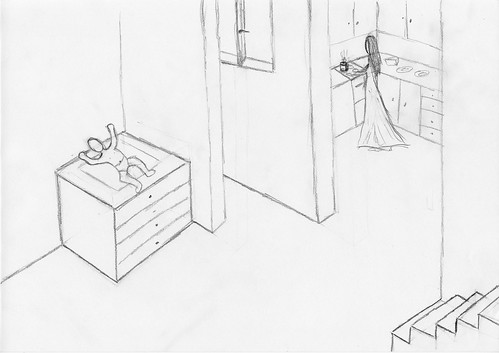
Mother is busy in the kitchen. The baby is waiting to be taken care of. It is crying, crying and crying. The baby is noisy and needy but it does not get picked up.


It’s not mother’s fault because she is simply busy. It’s the baby’s fault.


Father is working and mother is overloaded. She is just young and has duties that she never had to deal with before. The baby is just one extra duty on a long list. The baby is not 1 year old yet. It is not an emotional priority.


Why should this baby come first. Mother was overloaded and creates a sense of guilt in the child.


It thought, “I don’t deserve to get my needs met”. “I make mother’s life harder, it would be better if I was not here”.

------------------------

Comment on story

In terms of the fight, flight or freeze response to stress there is clearly no fight response in this case. It shows how the suicide decision can result in such circumstances as it did here. The baby does not view mother as treating it unfairly which would tend to be the fight response, “I am not being treated in the way that I should be, so its their fault” (anger).


Instead the response is to see mother as being over burdened with her domestic duties already and the baby is simply making mother’s life harder, thus it is the baby’s fault for it not being picked up. Thus it is not hard for the child to make the decision that things would be better for all concerned if it was not here. One could see this as the flight response and the feeling reaction is one of sadness and passive acceptance.


In being questioned on this scene the individual found it hard to say what her thoughts and feelings were. She stated that there were very few words and there was more feelings and noises instead. This gives the indication that the suicide decision in this case could be pre-verbal which also fits with the child being less than one year old.


If this is the case then one knows that the decisions made in this scene, including the suicide decision are going to be very resilient because they were made at such a young age before the child even had language. This implies that this individual will to some extent be potentially suicidal all her life. These very early decisions form the foundations of the personality and thus they are hard to alter through counselling compared to decisions made at older ages. The impact of the decisions can be changed but to expect them to be completely altered would be quite unusual and unrealistic. Thus there will always be a suicide decision there to some extent.


Of course a person of less than one year old can not recall such events as described and drawn here. For the purposes at hand it does not matter if it actually happened or not. These drawings and descriptions are really just visual, cognitive and kinaesthetic representations in the person’s mind, of the structure of their personality. This event describes part of the personality for instance in cognitive behavioural therapy terms, the thinking errors the person has. It does not matter if the event even occurred as it is the visual, cognitive and kinaesthetic representation the person currently holds in their mind which allows them to have consistent personality structures. It is what the person uses to actually have a personality.


I have always been surprised at how easily people will produce these early distressing scenes as well as being convinced of their authenticity. There is never a sense of people making up a story or telling a tale and so forth. Instead they produce a drawing of what they believed happened to them and as has been seen at times they can be quite elaborate and detailed. In addition the feelings and early decisions which were made as a result of the event can also be quite easily articulated.


Graffiti

Friday, December 4, 2009

The act of dying


This also illustrates another point that one hears mentioned from time to time by suicidal individuals. Some people are just too scared or simply can not ever imagine themselves going through with the actual act of killing self. They do not see it as a thing they could ever do whilst at the same time having quite strong self destructive urges.


However the self destructive urges will continue to demand to be expressed regardless, so one has to find another way of expressing them. One way is to have an 'accident' or alternatively to have someone else kill you which is sometimes colloquially referred to as 'death by cop'. This phenomena has been discussed many times in forensic and police journals (see Jenet and Segal (1985)). That is, one behaves in a way such that the police will kill you. Some murders in domestic violence could also be this kind of suicidal act.


There is a insightful article By K. van Wormer and C, Odiah (1999). These writers describe a phenomenon called “Suicide-murder” (not the usual “murder-suicide”), because in this instance suicide is not viewed as a consequence of murder but as its cause. They cite research evidence based on case studies done in prisons with males who committed murders in states where the death penalty existed for such crimes.


They suggest that in some instances part of the motivation to commit the crime was so the state will kill them by execution. They were motivated at least in part by suicidal urges but felt they could never actually go through with the suicidal act so they behaved in such a way that the state would kill them. Many of the men presented in the case studies were clearly suicidal and some demonstrated they had clearly plotted their deaths long before arriving on death row.


In addition they discuss what they term voluntary executions. In the United States there were two hundred and twenty three executions between 1976 and 1993. Twenty nine of those were consensual or at the inmates request. In another study they report sixteen examples of men on death row who volunteered for the death penalty, usually by refusing to fight appeals of their cases. Indeed another two of individuals who had requested an execution were subsequently found innocent and released!


Each of these men chose death as a solution to their problems. They did not die by their own hand but chose to die by having the state kill them. Clearly these cases involved a conscious decision to die that persisted over a significant length of time and was carried out. This is a strong indicator that these men had made the suicidal decision early in their lives and it remained in their psyche until circumstances they created resulted in them enacting that solution to solve their problems.


Graffiti

Sunday, November 29, 2009

Three reaction to stress & suicide


Solutions to problems or high stress. It is generally acknowledged that the more a person is placed under stress the more they will revert to their childhood solutions to problems and the more they will regress, as it is known. This means they move from the Parent and Adult ego state into the Child ego state as is shown in the diagram 1 below.


Diagram 1


This illustration shows that as one is placed under more and more stress, the more they will revert to their early ways of thinking, feeling and behaving. The more childlike they will become in their thinking and behavior and the more obvious their early decisions become in how they behave. They move from their grownup Adult and Parent ego states into the Child ego state part of self. This is supported by research in neuro-psychology as is shown by Johnston (2009). When people are placed under stress they are less able to access the pre-frontal cortex of the brain which is associated with the more developed functions like problem solving, decision making and stress management. Instead people will tend to access the more primitive part of the brain in the amygdala.


When this happens the early decisions about how they should think and feel become more pronounced. These early decisions influence the current decision making much more than if the Parent and Adult ego states were fully operational. As a result one finds such people making decisions that may seem quite out of character for them Decisions can be made which seem odd and even bizarre based on the facts at the time because it is the early child like thinking that is dominating in the personality.


Generally there are regarded to be three main responses to high stress. In 1915 an American physiologist called Walter Cannon described the fight or flight response. This is a fundamental response to a threat or perceived attack where the person will either fight the attacker or flee from them. Since that time another response has been added and that is the freeze response where the person does not either attack back or flee they just freeze and end up doing nothing. This freeze response is seen as the ‘playing dead’ reaction. In the animal kingdom sometimes an animal will play dead so that its attacker thinks it is dead, becomes bored and then moves away. A good example of this is the mouse who is caught by a cat. It plays dead in the hope that the cat will tire of it all and become distracted onto something else.


Everyone has used all three at some time but we all will have one basic response that we use when there is a very high threat or very high level of stress. It is our last bastion when all other options have been tried. Our most basic response to stress of course will be the one that we decided upon as a young child and which fits most with our basic temperament. Our temperament will effect our decision making to varying degrees and thus will effect wether we choose fight, flight or freeze as our primary solution to problems and stress.


Fight, flight or freeze?


Below are some behavioral examples of how a person may respond to threat in each of the three ways.


Fight - this person may physically hit out (as can be the case in domestic violence), verbally hit out, fight for their rights, put in a complaint or sue somebody. In childhood this is the child who will hit out, shout in their defense, maybe break property or try and hurt the other person in some way. The primary response is to fight up against the adversary either overtly or covertly. When under great stress this person will tend to hit out at others physically or verbally. In childhood the child may voice disapproval at mother and father or seek to angrily get change in some way in the home. If mother and father are fighting the child may actually seek to intervene in some way between them.


Flight - This solution may include things like using alcohol, drugs or prescription medication. All these are a way of getting away from the problem as a means to solving it. The person who quits their job and simply goes elsewhere. Here one chooses to geographically relocate or to move away from the problem thus solving it in their mind. In childhood the youngster may display running away from home behavior or the child may go and hide under their bed as a response to stress in the home. Unlike the fighter this child does not seek to change the conditions in the home or express their disapproval instead they move away from the problem and wait for it to subside. They want to ‘slide under the radar’.


Freeze - In earlier times this person would have been diagnosed as having a nervous breakdown. In essence the person collapses in on self and goes into a state of incapacitation. They simply fall to the ground or crawl into bed and go into the fetal position. These days people go on stress leave from work, they may seek hospitalization, some can have panic attacks and agoraphobia which are both incapacitating conditions that can keep them home bound. In childhood the child just stands there and simply does not know how to respond. In the extreme they can loose bowel or bladder control. Whereas fight is primarily an angry response, freeze is mainly an anxiety response.


Suicide primarily is a flight response. One solves the problem by getting away from it and suicide does indeed do that. Interestingly enough in the histories of suicidal individuals it is not uncommon to hear of them report running away from home behavior which of course is the flight response as well. Most often if a child says they are going to run away from home, when asked where they are going to run to they has no answer. In essence the child is running away to oblivion.


Suicidal individuals are in a state of considerable distress and often confronted with some very difficult problem whether that be a recent event that has occurred or just an increasing state of malaise, melancholy and distress that has evolved over time. Thus they will act in more child like ways as mentioned before. When taking a client's history they reports flight as a main way of dealing with stress then this is another point to note when making a suicide risk assessment.


All people fight suicidal urges to some degree. If they did not then it would not be long before their did indeed die. If however the person has a primary flight response then they will be more willing to give up on the fight and take the flight solution of suicide. If the person has a strong fight response then you know they will be less likely to give up and make a serious suicide attempt. The no suicide contract can be particularly useful for this type of indidivual. They can use it as part of their fight response.


Counselling generally speaking is a fight response. Client's wish to identify the problem, find the cause of the problem and then change it rather than simply moving away from the problem. However this is not always the case. Some people will use counselling to identify the problem and then seek ways of getting away from it. Depending on what the problem is, either approach can be useful.


For instance if the client has a primary fight response and has a problematic relationship with mother they will tend to try and alter that relationship by changing self or by negotiation. Those with the flight response will not try so much to alter the relationship but will tend to take the solution of simply never seeing mother again. Some people come to counselling to get permission to do precisely that. To get approval from the counsellor and make a decision to terminate the relationship with mother. Obviously as a therapist it is conducive to work out which of these responses the client is essentially looking for.


Those with the flight response are much more likely to seek a purely medication approach to their problems of emotional distress. For instance the medication approach to depression is a example of a flight response. If it is found to be successful then that person would have little interest in seeking a counselling approach as well. On the other hand one not uncommonly meets clients who say they don't like taking medication as it does not solve the problem and they will seek to find the cause of the problem and try and remediate that.


Sometimes the fight response can be the problem in the itself. If the person has a toxic relationship with their mother that brings them great angst they can seek to change it. The problem with changing relationships is it usually requires both parties change. If mother refuses to then there is not much you can do about that. The person with the fight response will tend to continue to try to change the relationship (mother).


Sometimes it is very hard to accept

that things can not be changed


Some things you cannot change and the person with the fight response will have trouble identifying those times and will get stuck trying to change the unchangeable. The therapeutic goal in these circumstances is for the person to give up their fight which some can find very hard to do.


Graffiti

Thursday, October 15, 2009

Is suicide an angry act? (editted)

Some time ago I would answered yes, this was the case but I have tended to change my views over time or perhaps refine them over time.


There is a view that the more a person has difficulty expressing aggression or anger then the likelihood of suicide increases as the anger gets turned in on self. In support of this such research is quoted


Horesh et al (1997)

“Anger correlated significantly with suicide risk. Higher anger contributed synergistically to the suicide risk.”


DiGiuseppe et al(2007)

“Increasing evidence indicates that aggressive behaviour may be related to suicidal ideation and attempts. Many adolescents report intense anger immediately prior to their suicidal gestures. In one study, a third of adolescents who completed suicide displayed anger as their predominant mood just prior to their deaths.”


“Prior to suicide attempts adolescents may engage in intense verbal attacks or display physical aggression towards objects or people”


DiGiuseppe et al(2007) also conclude that anger inward turned has a higher correlation to hopelessness in suicidal adolescents than anger outward turned. However the outward turned is also correlated as well.


One firstly needs to identify the possibilities with anger


It seems reasonable to concur with the research. If a person has made the suicidal decision (“Don’t exist”) and they have high levels anger then they could be assessed as being at a higher risk of making some suicide action.


This would seem to be particularly so if the anger tends to be inward turned rather than expressed outwards as is shown in the diagram but I would also concur with the last conclusion of the research that there is also a correlation with outward turned anger as well.


When one sees a client who has inward turned anger one of the treatment directions is to get them to identify a thing or person to whom they could also direct some of the anger. The anger starts to be directed at something outside the person and thus one would assume that less of it is directed at the individual them self. This is a typical scenario in the treatment of depressed people.


However whilst the correlation was higher with inward directed anger there still was a correlation with outward directed anger. Getting the anger outward directed is better but still not the full solution. Why would this be so?


I have said before that psychologically there is some similarity between the murderer and the suicidal as well as some psychological similarity between the self harming person and the person who harms others. Some seem to find this hard to understand and take it as me saying that self harmers are in some way bad people for this. I am not saying such a thing and I have sought to find a metaphor that may make it clearer. I am not too sure if I have achieved this but I will give it a go anyway.


If I capable of speaking german then I can insult and verbally abuse others in that language. Or I can choose to insult and verbally abuse myself in german. If I have no mastery of the german language I do not have the choice. I cannot verbally abuse others in german and I can not insult myself in german. The self harmer and the “others” harmer both have mastery of the same language. They have both decided that physical assault is a viable solution to a problem. The person who does not harm self or others does not speak the language so they are far less likely to do either.


Thus we get back to the diagram and the research. Anger directed at self could obviously be correlated to suicidal behaviour. However anger directed out at others could also be correlated (but less so) because they are still speaking the same language than the person who does not have such anger in the first place.


In the treatment of such a kind of depression, one would first want the inward turned anger to start being directed at an outward thing or person. Once done then one would be wanting the person to drop the anger and thus they start to loose mastery of that language entirely.


Whilst on the topic of anger and suicide one can make further assessment of suicide risk by enquiring about how a person would plan to kill self. The method chosen could be reflective of the degree of anger involved. The more destructive the method may indicate a higher degree of anger involved.


The less violent methods would be things like poisoning self, gassing self or perhaps drowning and even cutting self in a effective manner (ie not hacking away at self). The more violent methods would include shooting self in the head, throwing self under a train or jumping from a high building. However it seems that the penultimate expression of violence in the act of suicide would be self immolation. Without a doubt a very violent means of suicide and reflective of substantial angry feelings.


Thus it seems productive for a therapist to enquire about the method of suicide considered and if violent then one knows to further look into the level of anger felt by the client and how they deal with such feelings.


One also needs to consider temper tantrum type of anger. If one sees a young child have a temper tantrum one would notice how they lash out in an indiscriminate way. Temper tantrum anger is completely directionless anger. The child is enraged and expresses that rage by lashing out at anyone including itself.


What is meant to happen in normal child development is slowly the child learns about its anger and learns to recognise the stimuli for the anger and then its anger expression is focussed at the identified cause. Some however never master this psychological task of child development and thus you get some adults who have the temper tantrum type expression of anger where its expression is indiscriminate. Hence you can have some suicidal type of behaviours when the tantrum anger gets directed at self.


In my view this can explain the situation where a 19 year old man goes into a school, starts shooting at people indiscriminately and eventually suicides at the end of it all. A temper tantrum type expression of anger.


If a client presents as having made a suicide attempt that seems to be anger related it would be instructive to question as to the context of that attempt. Namely, around the time of the attempt did the client display other indiscriminate anger expression. If he did then one may be dealing with an individual who has a temper tantrum type of anger expression and the suicidal behaviour is a consequence of that.


I am reminded of one person who almost completed a suicide in these circumstances. When I was working in a prison there was one inmate who had a phone call with his girlfriend where she dumped him and told him the relationship was finished. His response to this in the space of about 30 seconds was to smash the phone, slit his throat with a razor blade which he obviously had on him at the time and throw himself head first off a 4 meter high landing onto a concrete floor. The medical reports showed that he very nearly died, but he did survive. Indeed after that the other inmates referred to him as “Black magic” because he was black and it was magic that he did not die.


One could say that this suicide attempt was an angry act, but technically this is not correct. I got to know this man very well as that was my job in the prison, to identify and manage suicidal and self harming inmates. This man had not made the suicidal decision in childhood, he did not have a Don’t exist injunction.


What had happened was he was abandoned by his girlfriend to which he responded with rage. He then displayed that rage in a temper tantrum type of way. He damaged property (the phone) and then attacked himself (fortunately there was no one standing nearby or they may have been attacked as well).


His goal was not to kill himself, so technically it was not a suicide attempt, he was simply enraged and he expressed that anger in a temper tantrum where at one point he attacked him self. In such instances one gets the unplanned and spontaneous type of suicide attempts and thus many of them are not completed. In this case his anger was very reactive anger.


One can have other temper tantrum type of anger that is not reactive anger but is based on character anger. Thus an event does not happen that sparks the tantrum like anger but the person has character anger deep inside that pervades over time. In these circumstances one can get well planned suicidal and murderous acts. An example of this could be Martin Bryant.


He was an Australian in his early 20s. At one point he took a number of guns and considerable ammunition to a home where he shot dead two people he knew. After that he left and went to a popular tourist resort and randomly shot dead another 33 people. Any person, man woman or child who got in his sights he shot dead. At the sentencing the judge stated in part:


“The prisoner, having had a murderous plan in contemplation and active

preparation for some time, deliberately killed two persons against whom he held a

grudge, and then embarked on a trail of devastation which took the lives of a

further 33 other human beings who were total strangers to him and which caused

serious injury, distress and grief to literally thousands more. The repercussions

of these crimes have been world-wide. His selection of victims was

indiscriminate. He killed and injured men, women and even children”. (end quote)


After he killed the people at the tourist resort he left and went to a house where he set him self on fire in an attempt to kill himself. He survived the attempt and remains alive today.


Thus we have temper tantrum type behaviour. The indiscriminate killing of others and eventually the attempt to kill self. We have an instance of firstly controlled and thought out anger directed at a distinct target and then indiscriminate directionless anger expression.


Even in murder children will display a child like quality.


As another example

The Boomtown Rats were at a US radio station for an interview when the story

of Brenda Spencer came over the news wire. A 16 year old California high

school student made headlines when she grabbed her father's gun and opened fire

on her school from a house across the street, injuring eight students and killing

the school's principal and custodian. When later asked why she'd gone on the

shooting spree, she responded "I don't like Mondays."


I Don't Like Mondays

by the Boomtown Rats


“The silicon chip inside her head

Gets switched to overload.

And nobody's gonna go to school today,

She's going to make them stay at home.

And daddy doesn't understand it,

He always said she was as good as gold.

And he can see no reason

'Cause there are no reasons

What reason do you need to be shown?


Tell me why?

I don't like Mondays”.


Hence we have apparently unexplainable behaviour which mystifies many. The temper tantrum explanation may give some insight into why such things do occur.

Graffiti