Showing posts with label life script. Show all posts

Friday, October 28, 2011

Eros and thanatos

INTRODUCTION
Any student of the psychotherapies would have heard the terms:
Eros and thanatos
Libido and mortido
Life instinct and the death instinct
If not, then they should have! Freud seized on this concept and it became central in his overall theory of human nature. In his book “The ego and the id” he discussed this theory of instincts at length.

Freud[1962] in his discussion of the two classes of instincts states that the first class is the sexual instincts or Eros. This is a "...self-preservative instinct,..."(P30). On the other hand there is the death instinct whose task it is to, "...lead organic life back into the inanimate state;..."(P30).
He is thus entering into the field of the philosophy of opposites. Human nature, life and the universe is unerringly a collection of opposites. The answer to the question, “Is it possible to have something that does not have an opposite?” begs unending cognition.

Hyams(1998) notes this in her article on dissociation. She says that the world is full of polarities - good/bad, inhaling/exhaling, high/low and so on. In addition there is yin/yang, protons/electrons, left/right, black/white, matter/anti-matter and so on endlessly. Does something exist that does not have an opposite? I am yet to think of one. As soon as one defines ‘x’, then ‘not x’ is also defined. However that is for the philosophers to conjugate over.

Mask face

THEORY OF OPPOSITES
Freud’s theory of these two instincts is a theory of opposites. One problem with such theories is they can become static. One discusses what is a manifestation of Eros (the life instinct) and what is a manifestation of Thanatos (the death instinct).
Eros = love, procreation, win/win situations, peace and cooperation, god.
Thanatos = hate, murder, game playing, war, devil.
This provides us with a static taxonomy of this theory. It is possible to look at how they interact and Freud does this to a certain extent in ‘The ego and the id’. He talks about love and hate being able to change into one another and how eating is both simutaneously constructive (gives life to consumer) and destructive (destroys the consumed product).

It is this point, in my view, that gets lost and is never taken far enough by Freud. This theory of insticts gets caught up in a right/wrong or good/bad morality. His bipartite system has a moral basis which leads it into trouble. It follows on from the same moral view that has been held by many if not all religions throughout time.

Life, growth, creation is good vs death and destruction is bad. In religious terms we have good and evil and god and the devil. The church has for all time seen god as good and the devil as bad and we must behave and think in a way that allows to be with god and defeat the devil. The only true way to defeat the devil is to not define god. As soon as one defines god, one defines the devil at least in part - the devil = non-god. If you do not define god then the devil cannot exist. If it does not exist then it is ‘beaten’ in one sense.

Spider woman

MORAL BASIS OF PSYCHOTHERAPY
This god vs devil or eros vs thanatos are static models based on a moral principle as suggested before. Thus we have the very basis for the moral underpinnings of psychotherapy.
Thanatos vs Eros = games vs intimacy, aggression vs assertion, I’m not OK vs I’m OK, win/lose vs win/win, competition vs cooperation, script vs autonomy. Some now argue they do not hold to such a moral view, as Transactional Analysts they work with the client and hold no judgements as to what is right and wrong.

In my view - balderdash. How many books on TA describe how to increase game behaviour and decrease the capacity for intimacy. How many describe how to avoid intimacy and increase script bound thinking and feeling. Transactional analysis is based on (as are all psychotherapies) a set of moral judgements about what constitutes life & growth and what constitutes death and destruction. What constitutes health and what constitutes pathology is central to any psychotherapy.

Base jumper 2

EROS & THANATOS VIEWED DYNAMICALLY
Let us take the static model of Freud’s bipartite theory and look at it as a dynamic model. Once done we end up with a very different situation. This allows us to go beyond examining the two insticts and what they represent in thinking, feeling and behaving. Instead it leads us to 3 new questions:

1. Are Eros and Thanatos interacting or not?
2 When they do not interact what happens?
3 When they do intereact what happens?
These three questions lead us to yet another set of opposites - change vs inertia.

What would happen if all the poeple on earth suddenly came to their senses and were able to tap totally into their eros energy and avoid all their thanatos energy? Governments would stop spending trillons of dollars on building bombs and weaponery and put all that money into psychotherapy and medical science. With all the advances taking place eventually people would than be able to live good quality lives until, they were 150 years old. What would the planet be like then. Firstly, governments of the world would rapidly bring out one child policies and these would even more rapidly become ‘no child policies’ or ‘very few child policies’. We end up in a state of inertia - little change. If we could all tap into the good growth, creative energy of the universe we end up static, in a state of inertia. When the eros instinct over rides its opposite for too long this is where we end up. If the thanatos instinct over rides then we end up in a similar state. Everything is destroyed, nothing is created and we end up inert again.

As transactional analysts this means we must be aware that it is essential that we remain playing games at some level and remain script bound to some degree. If we became script free then we end up inert. Thus we have one answer to the question about what happens when eros and thanatos do not interact.

So what happens when they do interact. Consider this other example that occured in Australia recently. There were massive bush fires in the eastern states of Australia. We saw images of huge flames, dead animals and huge areas of burnt out forests, All the reports were of how much devastation had been caused, how much bush had been destroyed. Clearly thanatos had been at work and left massive destruction in its wake.

However this is incorrect. The bush had not been destroyed it had been changed. The pictures of huge blackened areas all left us with black, sorrowful feelings. These blackened areas should be a stimulus of great feelings of excitment, anticipation and joy, not of sorrow. Imagine the growth and creation of insects, rodents, vegetation that are now going to occur in these blackened areas. It will represent an expression of eros in its undiluted form, a thing which we all say is wonderful. If there had never been the thanatos of the fire then this eros could not have occured.

Baptism

DEATH PHOBIA
We humans are a death phobic species. We will do almost anything to avoid the pain that acts based on the thanatos instinct can bring. We spend millions of dollars on fire fighters and fire fighting equipment to reduce the “destruction” (ie thanatos, ie change) to a minimum.

Consider human reaction to endangered species like the elephant or lion - the Kings of the wild. What do we do. We create breeding in captivity programs in zoos. We create reserves for them to live in. These are called wild life parks. A nice term to alleviate our guilt. Lets be realistic wild life parks are the same as breeding in captivity. These wildlife parks and zoos are simply museums. They allow us and our children to see species as how they once were. A useful endeavour. But lets not pretend they are existing as they used to. Such parks and zoos allow us to observe the history of such species, not the now.

So why do not we just let all the elephants and lions die out. Let that symbol of evil and thanatos - the poacher - do his work and kill off all the remaining ones. Why do we not get it over and done with instead of stringing out the pain and trying to pretend that these species still exist. Why do not we accept that lions are extinct, its just that we do have some in a museum that we can go and look at from time to time?.

I do not have an answer. Perhaps it is a sign of some form of collective human guilt. Perhaps it is because we have accepted a static model of eros and thanatos or god and the devil. If we look at the same model dynamically then we see that with the extinction of the lion that opens up change and some form of species will be allowed to grow, develop or even be created that could never have happened with the presence of the lions. The poachers work allows eros (god) and thanatos (devil) to interact thus we do not remain in inertia but move into a change phase.

Skeleton face

PSYCHOTHERAPY AND THE DYNAMIC MODEL
How does this translate into psychotherapy and transactional analysis. All psychotherapies have some sort of statement on what is health and what is not. The majority spend a great deal of time defining such things. For instance in TA we have script and autonomy. Large amounts of time and energy have been spent on defining and diagnosing what are script thoughts, feelings and behaviours and what are not. Then just as much time is spent on how to treat or facilitate change of such thoughts and feelings.

How would people react to suggestions that:
“A divorce is to be as celebrated as much as a marriage”
“Game playing is essential to normal human growth and development”
“The srcipt free individual will wither and die over time”

This is what the dynamic model of eros and thanatos or the life and death instincts proposes. Up to date psychotherapies have been taken from the church or the (moral) static dichotomy of good and bad and the god and the devil.

devils

CONCLUSION
It seems erronous to view humans as having the two drives of eros and thanatos. Instead we have:

interaction/unbalance/change or stagnation/balance/homeostasis.

It is more reasoned to view these two drives as either interacting or not. If they are not dynamically involved then we have stagnation and non-life. If they are interacting then we have life.

REFERENCES
Freud, S. (1962). The ego and the id. New York: W.W. Norton.
Hyams, H. (1998) Dissociation: Definition, Diagnosis, Manifestations, and Therapy, with Special Reference to Cults/Sects. Transactional Analysis Journal. 28(3), 234 - 243.

Sunday, September 25, 2011

Melamary life script currency analysis

Results

uniqueness
one and only +
feelings ++
power +++
reverse status
sex ++
beauty
pied paper
booze ++
food +
violence
money ++
words +
drugs +

Analysis

Games - Rapo, cops and robbers, psychiatry
Stage - anal
Lifestyle/occupation - politics, examiners, critics, the “boss”. police, doctors, psychologists
Therapist - Supervisor / supervisee disputes, industrial mediation
Personality - paranoid, anti social
Issues - Control, penis envy, dependency

Car crash

Power is an interesting script currency and not an uncommon one. It is unfortunate in that the person tends to waste so much energy as they get caught in fights or disputes they do not need to and so much energy gets ‘wasted’ in this way. The person with the power script currency needs to ask self, “Do I need to be involved in this dispute”.

The young child has fight (compared to flight or freeze) as its primary response to parental control. Feeding, toileting and adolescence are especially crucial stages in this child’s development where parents need to be extra careful not to set up an adversarial relationship with the child in a battle for power and control. However it is not just these stages and it is all through the formative years that parents need to be careful with the ‘fight’ child.

Child trust

Power is a double edged sword in relationships. If one feels they have the power position in the relationship that can lead to a sense of safety because one is in control of what happens. However it is also tiring as one IS always in control and thus can never be ‘looked after’ by the other. In therapy the client is invited to take the dependent role in the relationship with the therapist. They may find this very difficult to do but if achieved they may feel a great sense of relief at not having to be the one expending all the energy being in charge.

The therapist needs to make sure that the therapeutic relationship does not become just yet another battle field for a fight over control, for the client. This does happen as therapists are the ones in the power position in the therapeutic relationship and thus those with a power script currency issues will be attracted to the profession.

Graffiti

Saturday, August 27, 2011

Annalynn life script currency analysis

Results


Uniqueness ++

One & Only +++

Feelings +

Power +

Reverse Status +

Sex

Beauty

Pied Piper

Booze +

Food +

Violence

Money

Words ++

Drugs


Analysis


N picture


You are quite unique Annalynn as this is quite an unusual set of results that you provide. The main thing I can say about it is that it could be reflective of disordered attachment. I know you a little bit but not a lot so I will have to speak more generally.


Research shows that children who grow up in a monomatric family will tend to have singular attachments in adulthood. This could be seen to represent the script currency of one and only and uniqueness. Especially the quality of the exclusion of others. Children who grow up in more polymatric families will have a more diverse set of attachments in adulthood.


In terms of psychological games this could result in what are called exclusion games. These are played the best of all by teenage girls. Those who establish peer groups and then keep some others out of them. This is not saying that you do such things just that you would be hypersensitive to such behaviour.


Because of the singular attachment there could develop problems with loyalty, betrayal and so forth, including exclusion games as mentioned before.


3 competing women


Of course there is nothing wrong or unhealthy about having singular attachments. From a psychological point of view if the needs for human contact are met in one or two attachments then there is no problem. Others usually have more attachments to meet those needs but as long as the needs are being meet then there is not a psychological problem.


The main danger is you put all your eggs in one basket. If the primary attachment figure dies or moves away then you may be left bereft of other attachments.


Graffiti

Kahless script currency analysis

Results


One and only ++

Reverse status ++

Drugs ++

Booze ++


Analysis


Booze and drugs


Games: alcoholic, cops & robbers

Psychosexual stage: Oral

Lifestyle/occupation: Gourmet, wine taster, narc, temperance league, junkie

Illnesses: Gastrointestinal, oral problems

Therapist: Addiction counselling

Personality: Antisocial, schizoid, narcissistic

Issues: Can be more severe in terms of life threatening, despair rather than depression


Dont look


Tends to result from pre-verbal quite early problems with the primary attachment figure. Primary attachment figures may be emotionally absent in some way.


May have a tendency to move to a position of non life if not obviously self destructive. Stroke deprivation can result when the individual enters periods of incapacitation (non life) which may last many months.


Possibility of openly self destructive behaviour with the use of alcohol and drugs but also by other means as well. Possible suicidal urges.


Smoker

The sophistication of smoking Peter Styvestant thins.


Quite amenable to psychotherapy but needs to find a good attachment figure in a therapist. If achieved then considerable psychological gains can result but it takes time.


Needs to structure life such that social isolation does not result even though there maybe a constant pull to that position.


Graffiti

Friday, August 26, 2011

Linda life script currency analysis

Results


Uniqueness +++

One and Only na

Tears and Feelings na

Sex + 

Violence n/a 

Pied Piper n/a

Drugs n/a

Booze n/a

Food +

Power na

Reverse Status ++

Words +++

Money ++

Beauty ++


Analysis


Words

Games: Psychiatry, Greenhouse

Psychosexual stage: Anal or possible oral

Lifestyle/occupation: Lawyer, politician, writer, journalist, orator, salesman, psychotherapist, debater

Illnesses: Elective mutism, migraines, neck/shoulder pain,

Therapist: Intellectual therapies are attractive

Personality: Obsessive compulsive, paranoid


Ladies in raincoats


Issues:

These people are sometimes said to be “Dead from the neck down”. They retreat to the safety of thinking and thus there can be a mind body split. Out of touch with their body and thus one can have eating disorders or various forms of self harming. Out of touch with what their body is saying and thus detached from part of the Free Child.


Retreat to intellectualisation so as to hide from feelings (at least some of the painful ones).


Pro-ana4


Need to access the Free Child in therapy. The Free Child has gone into hiding for some very good reason and accessing it will bring up those reasons which may be quite distressing.


Body therapies might be an idea to deal with the mind body split. Physical contact needed as there may also be a history of prolonged stroke deprivation.


If it is a reflection of oral stage issues there could be obvious suicidal or self destructive impulses or more subliminal self destuctive impulses displayed through such things as alcohol abuse, chronic cigarette smoking or severe eating problems.


Graffiti

Thursday, August 25, 2011

Crocus life script currency analysis

Results


Uniqueness ++

One & Only +

Feelings +

Power +++

Reverse Status

Sex +

Beauty +

Pied Piper

Booze ++

Food ++

Violence

Money ++

Words +

Drugs ++


Analysis


Power

Games: Cops & robbers, rapo

Psychosexual stage: Anal

Lifestyle/occupation: Politics, examiners, critics, the ‘boss’, police, doctors, psychotherapists

Therapist: Supervisor-supervisee disputes, industrial mediation

Personality: Paranoid, Antisocial

Issues: Control, penis envy, dependency.


Woman with balloons

Rapo is a power based game


The life script is lived out via power in relationships with others. This is what will become the issue in relationships and the means by which psychological games in relationships are played out.


In the winner’s life script the power is used for the benefit of self and others. In the loser life script, power will leave the individual with dysfunctional relationships and in an unhealthy state of mind.


Powerful lady


The Adapted Child ego state will seek the power position in relationships and the Free Child will crave dependency in relationships. Therapeutic goal is to get to the dependency and have the client satisfy the craving for the powerless position in relationships.


Graffiti

Sunday, May 8, 2011

Final fantasy 6

Up to this juncture I have maintained the following psychological functions fantasy can provide

Fantasy as a defence mechanism
Fantasy in the schizoid personality structure
Fantasy to alter mood - self soothing
Fantasy as a source of strokes - positive and negative
Fantasy and life script reinforcement

It would seem that there are others

Fantasy in the narcissistic personality structure
I have mentioned this before that one feature of the DSM-IV criteria of the narcissistic personality is:

“Preoccupation with fantasises of unlimited success, power, brilliance, beauty, or ideal love.”

Thus it can be stated that fantasy is used by some narcissistic people to maintain that personality structure.

Lady & pig in mud bath

Fantasy as a reflection of current events in a persons life
As with sleep dreams, day dreams can occur as a reaction to events in a person’s life. If one is entering a new relationship they may have fantasies about how it will go or things the two people may do together and so forth. If the person gets a new job they may fantasise various scenarios about what might happen. This also happens in sleep dreams sometimes. When it does this reflects the psychological importance the current event has to the person.

Fantasy as wish fulfilment
This also occurs in sleep dreams. The daydream may be about what the person wishes. A relationship, money, success, sporting ability, their team winning the grand final, finding a lost child, to be the dependent one in a relationship and so forth.

Thus we have some of the ways fantasy can be used by the fantisizer. There may be others that come to light subsequently but at the moment we have this:

Fantasy as a defence mechanism
Fantasy in the schizoid personality structure
Fantasy to alter mood - self soothing
Fantasy as a source of strokes - positive and negative
Fantasy and life script reinforcement
Fantasy in the narcissistic personality structure
Fantasy as a reflection of current events in a persons life
Fantasy as wish fulfilment

XBOX party

There is one other point that must be made. This does not relate to the function of fantasy but how fantasy can be used in therapy. This I mentioned in final fantasy 5. If one maintains that daydreams are expressions of the unconscious or they arise from the unconscious, one can use them therapeutically the same way one would use dream analysis with sleep dreams. It is a way of understanding the unconscious of the individual.

For example Kahless stated:

“I used to day-dream being a secret agent, or a fireman, or Lara Croft”(end quote).

A therapist may ask of her,
What are the qualities of Lara Croft that are important in the fantasy?
What does Lara Croft do in the fantasy?
What is her relationship to others in the fantasy?

Of course the answer to each of these questions if simply a reflection of the psyche of Kahless. As with sleep dream work they each are part of her in some way. The therapist seeks to find out what those are and then finds a way to use them therapeutically. For instance it may become apparent that Kahless is not owning the Lara Croft in her. Some of the qualities she sees in Lara Croft she has in her own personality but is in denial about them at the moment. One could then use two chair to facilitate her accepting that part of her personality. As I also said in final fantasy 5 it is the theme that the therapist is looking for. The character of Lara Croft is not important. It is what that character means to Kahless that is important. The theme of the character and the theme of what the character does.

Of particular note with this is sexual fantasies. Whilst fantasy of heroic deeds or of great wealth can be used to understand the psyche, sexual fantasises have the extra feature of involving very close, intense and intimate relating. They involve at least two people interacting in a very close and intimate way. Fantasy about winning the grand final or being dux of the school does not have the same feature. Thus sexual fantasises assume extra importance in this way.

In using sexual fantasises in this way one firstly takes the sex out of the equation.
Forget about the sex and how are these two people relating?
If they were relating with the same theme in a non sexual way, what would they be doing?

Thus the unconscious wants, fears and needs involving intimate relationships becomes more defined. What the person’s unconscious feels about self and others and their relating becomes clearer.

Graffiti

Monday, May 10, 2010

What’s in a name? - Part 2


In the Transactional Analysis world over the years there has been sort of a tradition or cultural norm to change one’s name. Many have changed their name - christian name and/or surname, some have done it a number of times. I never have but at times it has been a bit of the thing to do.


However there is a theoretical basis for this tradition evolving. Eric Berne in his book, “What do you say after you say hello” talks about names and the role they can play in determining a persons life script. In therapy groups sometimes you get people who want to do some work on their name.


Over the years in many workshops and therapy groups I have begun with the round question for each participant - What is the story behind your name? Who named you and why? What does your name mean to you, your mother, and so on? Nicknames also can be very important, how they got them and what they mean to the person.


One never ceases to be amazed at some of the answers you get. Some people have whole elaborate stories or information that they know about their name and how they became named what they did. Some people come to realise that they know all this stuff about their name that they did not know they knew.


A man may report that he was named after uncle Harry and then describes how uncle Harry was a drunkard and a womaniser. As a 6 year old boy learns this what sort of impact is that going to have on his script. Or a woman reports that she is named after grandma Merle who was a spinster who spent her life doing good work in sub Saharan Africa. What sense is a little 6 year old girl going to make of all that?


Then there is the whole area of sex role scripting when a father wanted a boy and got a girl so he gives her a name like Kim. That type of thing can often result in a sense that there is something wrong within the child. In one sense your name is your public signature and thus it is seen as having some importance in one’s sense of identity as Eric Berne described.


My name is actually, Anthony Gilbert Browning White. Gilbert comes from my grandfather on my mother’s side - Gilbert Troup. What I have been told about him is that he was a very learned doctor and anaesthetist in this state for many years. My mother had a special attachment to her father and in one way revered him. When he died they created an award named after him that is given each year to the most successful student of anaesthesiology at a medical school here. On a side note about 5 years ago at a dinner function I attended, I discovered that the woman sitting opposite me had actually won it. Bit of an odd situation really.


I have spent my work life in the helping professions. Is this my life script from my naming?


However it is not all cheese and biscuits I may add. Whilst she revered him and felt a special connection to him I have learned over the years from her that he had a tendency to neglect his domestic duties. Whilst he was much loved by his patients he at times would tend to them before he tended to his own family. This as one can imagine resulted in some disquiet amongst family members including my mother who named me after him. Has this had an impact on my life script? Such are the vagaries of child development.


Graffiti

Thursday, March 4, 2010

Life script analysis 4


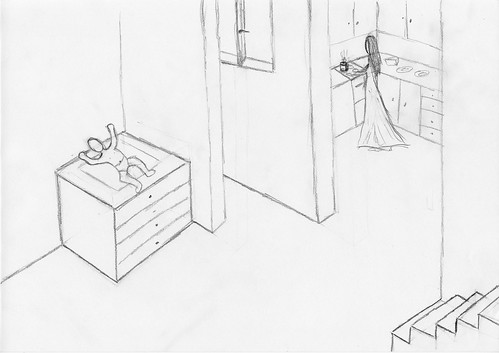
For a larger version of this go to here. And click on "All sizes"

Story of drawing.

Mother is busy in the kitchen. The baby is waiting to be taken care of. It is crying, crying and crying. The baby is noisy and needy but it does not get picked up.


It’s not mother’s fault because she is simply busy. It’s the baby’s fault.


Father is working and mother is overloaded. She is just young and has duties that she never had to deal with before. The baby is just one extra duty on a long list. The baby is not 1 year old yet. It is not an emotional priority.


Why should this baby come first. Mother was overloaded and creates a sense of guilt in the child.


It thought, “I don’t deserve to get my needs met”. “I make mother’s life harder, it would be better if I was not here”.

------------------------

Comment on story

In terms of the fight, flight or freeze response to stress there is clearly no fight response in this case. It shows how the suicide decision can result in such circumstances as it did here. The baby does not view mother as treating it unfairly which would tend to be the fight response, “I am not being treated in the way that I should be, so its their fault” (anger).


Instead the response is to see mother as being over burdened with her domestic duties already and the baby is simply making mother’s life harder, thus it is the baby’s fault for it not being picked up. Thus it is not hard for the child to make the decision that things would be better for all concerned if it was not here. One could see this as the flight response and the feeling reaction is one of sadness and passive acceptance.


In being questioned on this scene the individual found it hard to say what her thoughts and feelings were. She stated that there were very few words and there was more feelings and noises instead. This gives the indication that the suicide decision in this case could be pre-verbal which also fits with the child being less than one year old.


If this is the case then one knows that the decisions made in this scene, including the suicide decision are going to be very resilient because they were made at such a young age before the child even had language. This implies that this individual will to some extent be potentially suicidal all her life. These very early decisions form the foundations of the personality and thus they are hard to alter through counselling compared to decisions made at older ages. The impact of the decisions can be changed but to expect them to be completely altered would be quite unusual and unrealistic. Thus there will always be a suicide decision there to some extent.


Of course a person of less than one year old can not recall such events as described and drawn here. For the purposes at hand it does not matter if it actually happened or not. These drawings and descriptions are really just visual, cognitive and kinaesthetic representations in the person’s mind, of the structure of their personality. This event describes part of the personality for instance in cognitive behavioural therapy terms, the thinking errors the person has. It does not matter if the event even occurred as it is the visual, cognitive and kinaesthetic representation the person currently holds in their mind which allows them to have consistent personality structures. It is what the person uses to actually have a personality.


I have always been surprised at how easily people will produce these early distressing scenes as well as being convinced of their authenticity. There is never a sense of people making up a story or telling a tale and so forth. Instead they produce a drawing of what they believed happened to them and as has been seen at times they can be quite elaborate and detailed. In addition the feelings and early decisions which were made as a result of the event can also be quite easily articulated.


Graffiti